 Federico
 Stabilise
Take control of cash. Stop the bleeding. Build a weekly liquidity view that is reliable enough to make decisions on. Days, not months.
When an operation is losing money and the clock is running, the first job is not a strategy. It is control of the cash. I take that control, rebuild the cost base, and hand back a company with a plan it can actually fund.
A turnaround is not a report with recommendations. It is a sequence of decisions taken under time pressure, most of them unpopular, by someone who will still be there when they land. I have been that person — as Country Manager at Woden Group in Colombia and Peru, as Chief Financial Officer at Pierre-Fabre Brazil, and as Chief Executive Officer of Ezentis Brasil through its wind-down.
I work inside the company, not alongside it. That means the weekly cash view is mine to produce, the conversations with lenders and suppliers are mine to hold, and the headcount decisions are mine to defend. There is no team of analysts behind me preparing slides.
Take control of cash. Stop the bleeding. Build a weekly liquidity view that is reliable enough to make decisions on. Days, not months.
Rebuild the cost base, renegotiate with lenders and suppliers, and fix the operating processes that produced the loss in the first place.
A credible plan, the right people in the right seats, and a handover that leaves the company able to run it without me.
At Pierre-Fabre Brazil I ran the turnaround and recapitalisation of the operation, including one manufacturing site, and stabilised the JD Edwards Enterprise Resource Planning (ERP) system the finance team depended on. At Woden Group I did the same twice over, in Colombia with 820 people and in Peru with 250. At Ezentis Brasil the mandate was three months and binary: sell the subsidiary or shut it down. I found buyers and secured three offers; headquarters accepted none, so I ran the shutdown and the bankruptcy — a different job, and a harder one.
Usually within the first week. The weekly liquidity view is the first thing I build, because every other decision in a turnaround depends on it and most distressed companies do not have one they trust. It takes days, not months, and it is built from the company's own data rather than a model.
Either, and the choice is yours. In most turnarounds I take an accountable seat — Country Manager, General Manager or Chief Financial Officer (CFO) — because the decisions need someone who owns them. Where a capable team is already in place, I work alongside the Chief Executive Officer and the CFO and leave the seat to them.
The structured intervention is 90 days, which is long enough to stabilise and restructure and short enough to keep pressure on. Many engagements continue after that as a fractional or interim role while the rebuilt plan is executed. Fees are fixed for the 90 days once the situation is understood — usually after a first conversation and a look at the numbers.
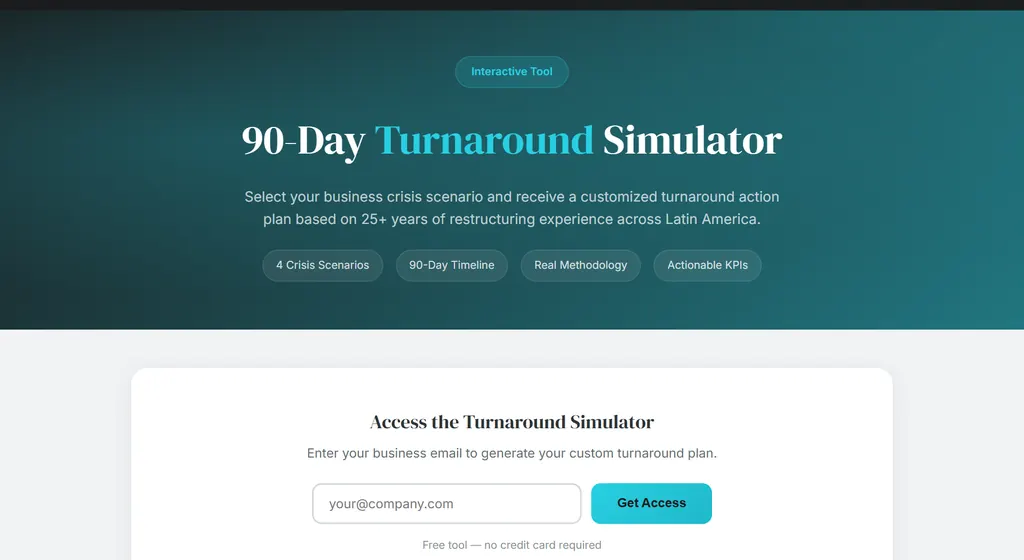
Select a crisis scenario, adjust the parameters for your company, and receive a 90-day action plan with milestones, KPIs and quick wins — based on 25+ years of restructuring in Latin America.
Try it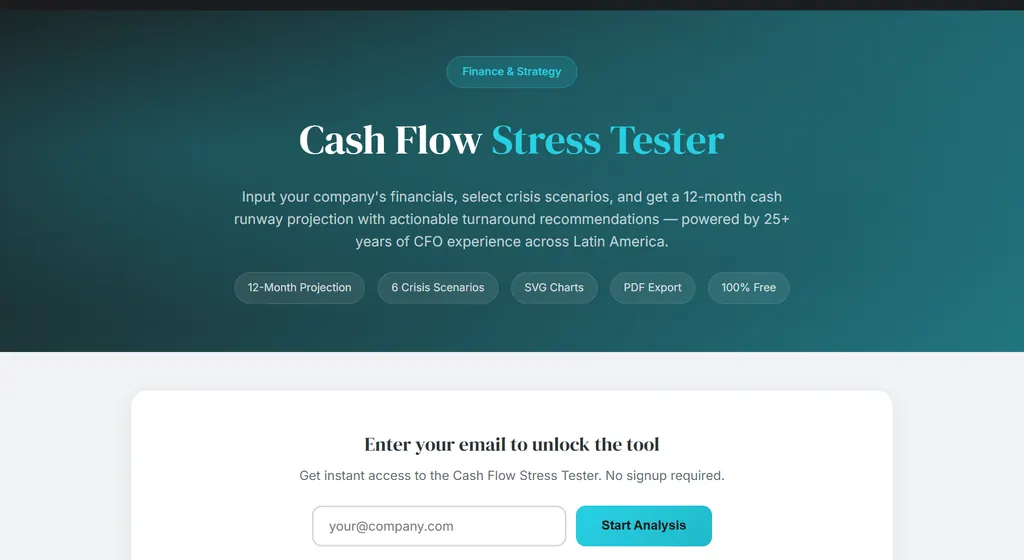
Enter your financials, pick the crisis (revenue decline, FX shock, cost spike) and get a twelve-month runway projection with turnaround recommendations and a PDF report.
Try itMost mid-market companies reach a point where the accountant is no longer enough and a full-time Chief Financial Officer (CFO) is not yet affordable. That gap is where I work — a few days a month, or full weeks during an event, with the same accountability as a permanent hire.
Sometimes the company does not need advice. It needs someone in the seat on Monday, carrying the profit-and-loss, making the decisions a departing executive left behind.
A 30-minute call, in English, Spanish, Portuguese or Italian. No deck, no pitch — you describe the situation and I tell you whether I am the right person for it.