 Federico
 Diagnose
Two weeks inside the numbers and the team. What the close actually produces, what the cash really does, where the controls are missing, who is carrying the function.
Most mid-market companies reach a point where the accountant is no longer enough and a full-time Chief Financial Officer (CFO) is not yet affordable. That gap is where I work — a few days a month, or full weeks during an event, with the same accountability as a permanent hire.
A fractional CFO is not a consultant who reviews your numbers. It is a C-level executive who owns them: the close, the controls, the treasury position, the board pack, the conversation with the bank. The difference from a permanent hire is the calendar and the cost, not the responsibility.
I have held the role in companies from thirty people to a 3,600-employee subsidiary, in Brazil, Colombia, Peru and across Europe. That range matters: the finance function a forty-person business needs is not a scaled-down version of a multinational's, and building the wrong one wastes a year.
Two weeks inside the numbers and the team. What the close actually produces, what the cash really does, where the controls are missing, who is carrying the function.
Fix the close, the forecast and the reporting line to the board. Put the controls in that the company's size justifies, and no more than that.
Hold the seat for as long as it is needed, and build the permanent answer underneath it — usually a controller or a first CFO I help you hire.
At Ardagh Group I was Chief Financial Officer for South America through the group's 2017 New York Stock Exchange listing, which meant reporting, controls and audit readiness good enough to survive that process, plus Sarbanes-Oxley compliance and an internal audit function built from nothing. At Ingersoll Rand I ran Latin America finance for the industrial sector; at Whirlpool's Embraco unit, finance, legal and Information Technology for a €350 million European operation. The same discipline scales down: the first thing a forty-person company needs is a close it can trust.
A fractional Chief Financial Officer (CFO) is an experienced financial executive who works part-time or on a project basis, giving a company C-level financial leadership without the cost of a full-time hire. Companies typically need one in three situations: they have outgrown a bookkeeper but cannot yet justify a full-time CFO; they are between CFOs and cannot afford a gap; or they face a specific event — a fundraise, an acquisition, a restructuring, an Enterprise Resource Planning (ERP) implementation — that demands senior financial leadership for a defined period.
Typically two to six days a month for an ongoing fractional role, concentrated around the close and the board cycle, with more during an event. It is charged as a fixed monthly retainer for a defined scope rather than by the hour, so the company knows the cost and I am not incentivised to stretch the work.
Yes, and usually that is the point. Most mid-market finance teams are competent and under-led. My job is to give them a structure, a calendar and standards, not to replace them — and where someone is genuinely in the wrong seat, to say so early rather than at the end.
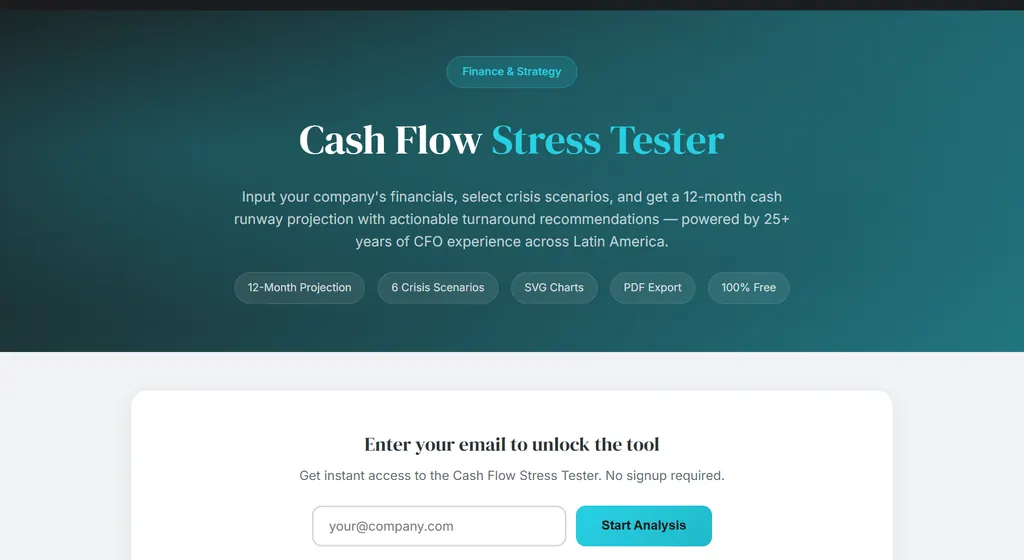
Enter your financials, pick the crisis (revenue decline, FX shock, cost spike) and get a twelve-month runway projection with turnaround recommendations and a PDF report.
Try it
100+ items across eight categories. Track progress, flag risks, add notes, export a professional PDF — built from real transaction experience in Latin America.
Try itWhen an operation is losing money and the clock is running, the first job is not a strategy. It is control of the cash. I take that control, rebuild the cost base, and hand back a company with a plan it can actually fund.
Sometimes the company does not need advice. It needs someone in the seat on Monday, carrying the profit-and-loss, making the decisions a departing executive left behind.
A 30-minute call, in English, Spanish, Portuguese or Italian. No deck, no pitch — you describe the situation and I tell you whether I am the right person for it.