 Federico
 Diligence
The operating read: cost base, working capital, customer concentration, the people who actually run it, and what breaks if they leave.
Deals are won or lost after signing. I work on the side that has to live with the result: the diligence that asks the operating questions, and the integration or the exit that follows.
Bankers price a deal and lawyers paper it. Neither is accountable for the business on the Monday after closing. I come in as the operating and financial counterpart: what the numbers mean, what the target's management is not saying, what the integration actually costs, and what the first hundred days have to deliver.
I have been on every side of this. Acquisitions and a greenfield entry at Ingersoll Rand. A New York Stock Exchange listing process at Ardagh. And the hardest version — a mandate to sell a 3,600-person subsidiary where the offers came in and headquarters turned them down, so the alternative had to be executed instead.
The operating read: cost base, working capital, customer concentration, the people who actually run it, and what breaks if they leave.
Alongside the bankers and lawyers, holding the operating and financial position — including the parts of the agreement that will be hard to live with.
The first hundred days, costed and owned. Or, where that is the mandate, a clean exit, including the version nobody wants to run.
At Ingersoll Rand I executed one greenfield entry and one acquisition for Latin America. At Ardagh Group I was Chief Financial Officer for South America through the group's 2017 New York Stock Exchange listing, which is a diligence process of its own kind. And at Ezentis Brasil the mandate was to sell a 3,600-person subsidiary in three months: I sourced buyers and secured three offers, headquarters accepted none, and the wind-down and bankruptcy became my job instead.
No. The bank runs the process and prices the deal. I am the operating and financial counterpart who reads the target as a business rather than a model, and who is still there when the integration has to be executed. On smaller mid-market deals there is often no bank at all, and then the roles merge.
Whether the cost base is reproducible after the owner leaves, how concentrated the customers and the key people really are, what the systems can and cannot do, and what the first hundred days will cost. Financial diligence tells you what happened; the operating read tells you what will happen.
Yes, and that is work most advisers avoid. I have run it: a three-month mandate to sell or shut a 3,600-person subsidiary, offers secured and refused, and the wind-down executed afterwards. Done properly it protects the group's reputation, its people and its remaining liabilities; done badly it costs more than the business was worth.
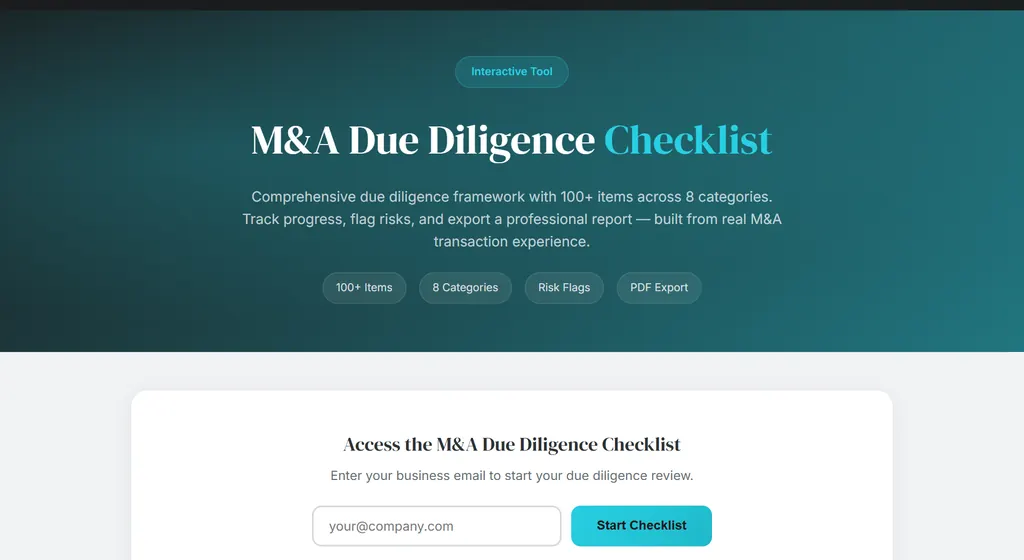
100+ items across eight categories. Track progress, flag risks, add notes, export a professional PDF — built from real transaction experience in Latin America.
Try it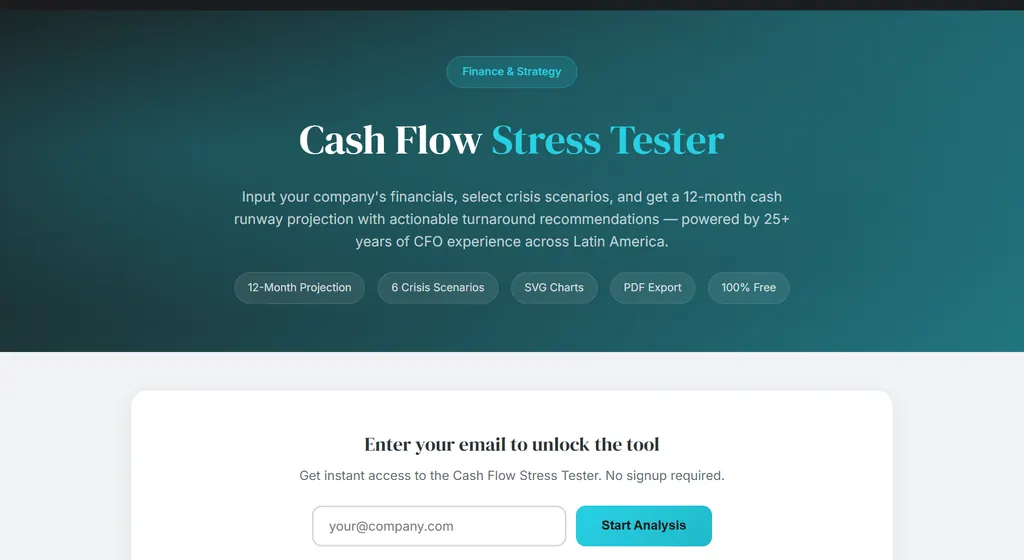
Enter your financials, pick the crisis (revenue decline, FX shock, cost spike) and get a twelve-month runway projection with turnaround recommendations and a PDF report.
Try itWhen an operation is losing money and the clock is running, the first job is not a strategy. It is control of the cash. I take that control, rebuild the cost base, and hand back a company with a plan it can actually fund.
Latin American tax regimes reward companies that understand them and punish companies that assume they work like anywhere else. The same is true of moving cash across the region.
A 30-minute call, in English, Spanish, Portuguese or Italian. No deck, no pitch — you describe the situation and I tell you whether I am the right person for it.